A welder can interview well, show up with the right PPE, and still fail a fit-up test that costs your crew a day of rework. The best ways to assess welders go beyond asking where they worked last. You need proof that a candidate can produce sound welds in the process, position, material, and job conditions your project requires.
For construction employers, this is not about creating a longer hiring process. It is about reducing bad hires, safety exposure, failed inspections, and schedule pressure. A focused assessment process can tell you far more in one day than a resume can tell you in ten minutes.
Start With the Actual Work, Not a Generic Job Title
“Welder” is too broad to be a hiring standard. A structural steel welder working FCAW on beams may not be the right person for GTAW stainless pipe work. Someone who excels at shop fabrication may need time to adjust to elevated field work, changing weather, tight access, or demanding production targets.
Before reviewing candidates, define the work in plain operational terms. Identify the base metals, thickness range, welding processes, joint types, positions, code requirements, work setting, and expected production volume. Clarify whether the role includes fitting, layout, blueprint reading, gouging, grinding, or equipment maintenance.
This step creates a fair assessment standard. It also helps candidates understand what they are being asked to prove. A good welder should not be screened out because a test is unrelated to the job. At the same time, a candidate should not be hired based on a qualification that does not match the work ahead.
Verify Certifications and Qualification Records
Credentials matter, but they are a starting point, not a final answer. Ask candidates for current welding certifications, qualification test records, and any code-specific documentation relevant to the project. Depending on the work, that may involve AWS, ASME, API, or customer-specific qualifications.
Review the details. A certification should show the process, position, base material, thickness range, filler metal, and testing method. A 3G plate certification does not automatically prove capability for 6G pipe. A qualification from several years ago may not reflect recent hands-on experience, particularly if the worker has moved into supervision, fabrication management, or another trade.
Also verify that the document belongs to the candidate and has not expired. Direct confirmation with a previous employer, testing facility, or credential issuer can prevent avoidable mistakes. Verification is especially valuable when staffing quickly for shutdowns, structural work, or high-consequence projects.
Use a Job-Related Practical Weld Test
The practical test is often the clearest way to assess a welder. Keep it tied to the position. If the job requires vertical-up stick welding on structural connections, test that skill. If it requires TIG root passes on sanitary stainless piping, create a controlled version of that task.
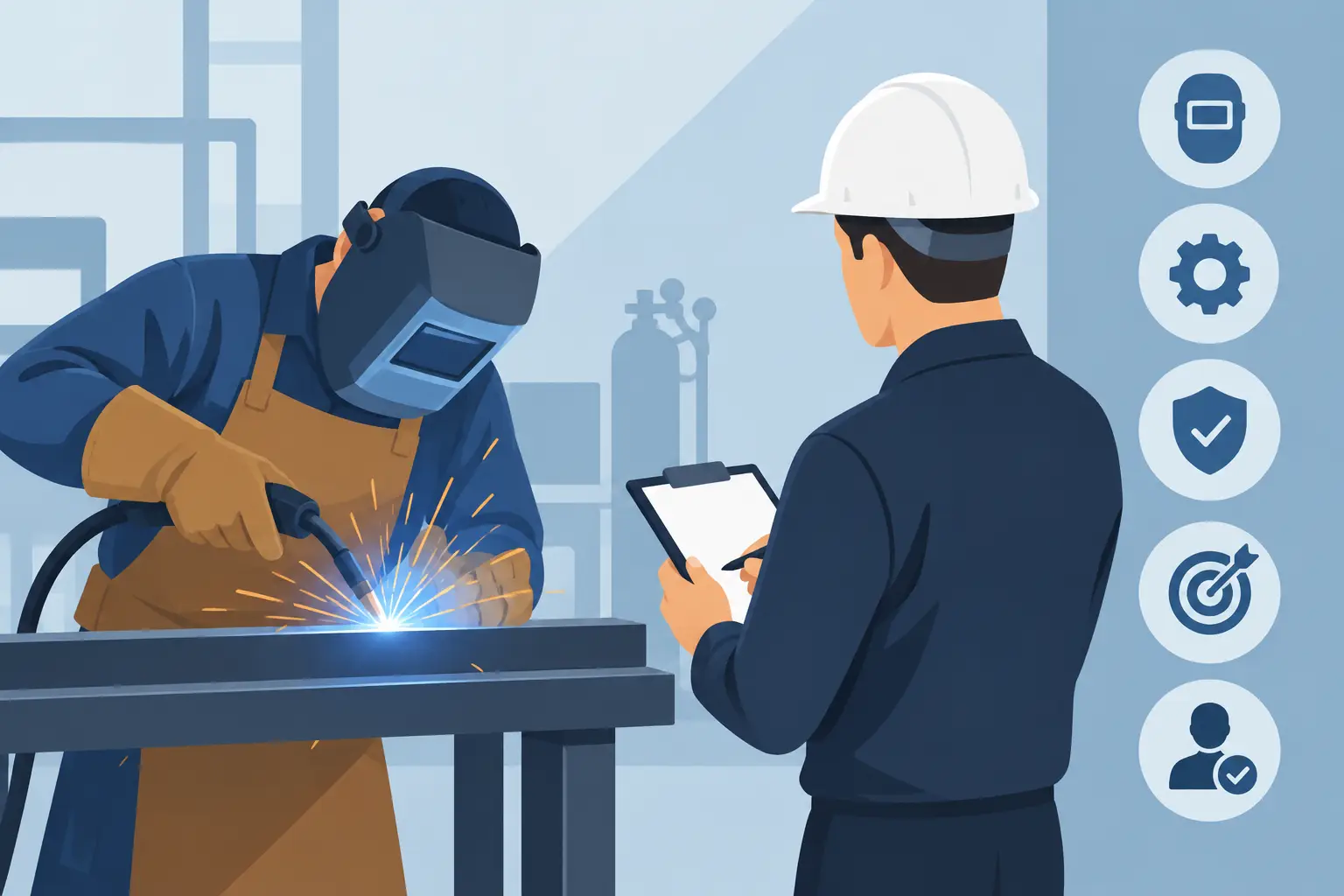
The test should evaluate more than the finished bead. Watch how the candidate prepares material, sets up the machine, selects consumables, manages heat, holds travel speed, and cleans between passes. These habits often reveal the difference between a person who can make a pass look acceptable and a professional who can produce repeatable work.
A qualified supervisor, welding inspector, or lead welder should score the test against clear criteria. Assess the following areas consistently:
- Joint preparation, fit-up, tack quality, and material cleanliness
- Machine setup, electrode or wire selection, and parameter control
- Bead profile, penetration, fusion, starts and stops, and weld continuity
- Common defects such as undercut, overlap, porosity, slag inclusions, and cracking
- Safe work habits, including PPE use, grounding, cable condition, and fire prevention
For code work, visual inspection alone may not be sufficient. Use the inspection or testing method required by the job, which may include bend tests, macroetch testing, radiographic testing, ultrasonic testing, or other nondestructive examination. The right level of testing depends on the project specification and the risk of failure.
Review Portfolios for Evidence of Relevant Work
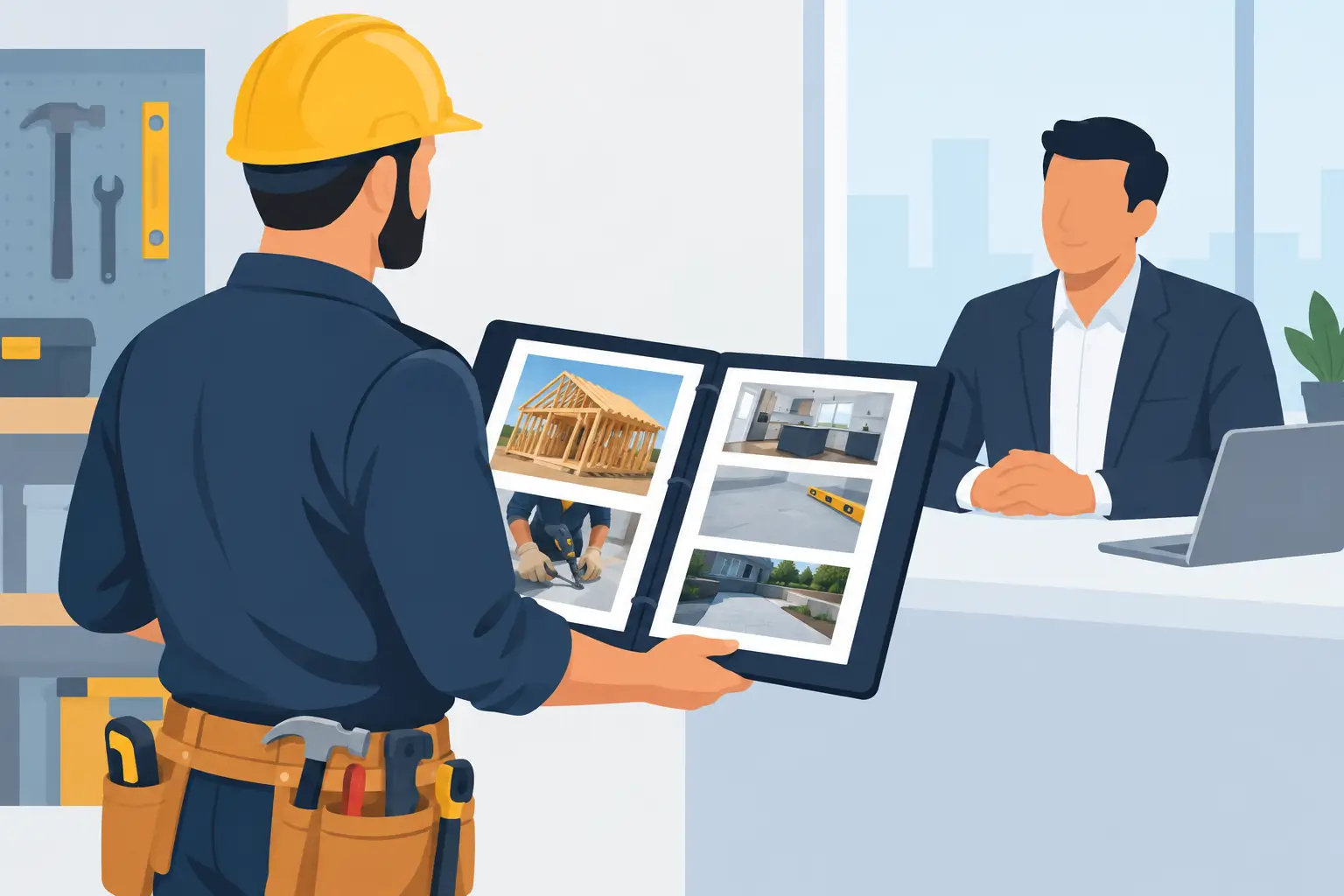
A portfolio gives context that a certification cannot. Ask welders to share photos or videos of completed work, especially projects similar to yours. Strong portfolios show clean fit-up, consistent weld appearance, finished assemblies, installation conditions, and the scale of work completed.
Treat photos as supporting evidence, not proof by themselves. Images can be old, edited, or taken from a crew project where the candidate performed only part of the work. Use the portfolio to drive better questions: What process did you use? What was the weld procedure? How did you control distortion? What inspection did the work receive? What would you do differently on the next project?
The best candidates can explain their work clearly without overselling it. They understand why a joint was prepared a certain way, how material behavior changed with thickness, and what quality checks mattered before the work moved downstream.
Ask Technical Interview Questions That Reveal Judgment
A welding interview should test decision-making, not just terminology. Open-ended questions are more useful than asking someone to define a process from memory. Give candidates realistic scenarios that reflect your jobs.
For example, ask what they would check if a weld begins producing porosity after running clean beads earlier in the shift. A capable welder may discuss contaminated base metal, damp consumables, shielding gas flow, leaks, wind, incorrect polarity, or changes in technique. Then ask how they would isolate the cause before continuing production.
You can also ask how they would handle a poor fit-up, a weld that fails visual inspection, or a drawing that conflicts with field conditions. Listen for ownership. The right response is not “I would just weld it.” It is a practical sequence: stop, assess, communicate with the lead or inspector, and correct the issue before it becomes expensive rework.
Check Reliability, Safety, and Crew Fit
Technical skill gets a welder through the gate. Reliability keeps the project moving. Reference checks should cover attendance, pace, rework rates, ability to follow direction, attitude toward quality control, and safety performance. Ask former supervisors whether they would rehire the person for similar work and why.
Safety deserves its own assessment. Welding hazards include fumes, burns, electrical shock, fire, confined spaces, overhead work, and hot-work coordination. A candidate does not need to recite every OSHA rule, but they should demonstrate sound field awareness. Watch whether they inspect leads, use appropriate PPE, protect nearby workers, and respect permits and site procedures.
Crew fit matters too, especially on fast-moving jobs. Some welders are highly skilled but work best in a controlled shop environment. Others are strong field contributors who can adapt to changing conditions, coordinate with fitters and ironworkers, and keep quality steady under pressure. Neither profile is automatically better. The right choice depends on the assignment.
Build a Consistent Scorecard
Hiring by instinct alone creates inconsistent results. A simple scorecard helps your team compare candidates fairly and move faster. Weight the categories based on the role. For a code-critical pipe position, practical test results and current qualifications may carry the most weight. For a production fabrication role, speed, consistency, and blueprint reading may matter more.
Use the same scorecard for every candidate considered for the same opening. Record specific observations, not vague impressions. “Needed repeated instruction on machine setup” is useful. “Did not seem experienced” is not. This documentation supports better hiring decisions and gives your team a benchmark for future recruiting.
A trade-focused hiring platform can also reduce the front-end work. Verified profiles, employment history, credentials, and project portfolios give employers a stronger starting point before scheduling a test. With go2work, teams can narrow the field to candidates whose documented experience aligns with the work, then reserve hands-on testing for the people most likely to succeed.
Avoid the Two Most Common Assessment Mistakes
The first mistake is overvaluing a beautiful test coupon. A candidate may perform well in a quiet, controlled test area but struggle with production pace, field access, poor fit-up, or changing site conditions. Pair the test with work-history verification and scenario-based questions.
The second mistake is rejecting a strong candidate because they do not match an overly narrow checklist. If someone has excellent transferable experience but lacks one process or position, consider whether a short qualification period, supervised test, or targeted training could close the gap. That approach only makes sense when the work, code requirements, schedule, and risk level allow it.
The goal is not to find a mythical welder who can do everything. It is to hire a qualified professional whose proven skills match the work in front of your crew. When your assessment reflects the real job, the right candidate becomes much easier to identify.