
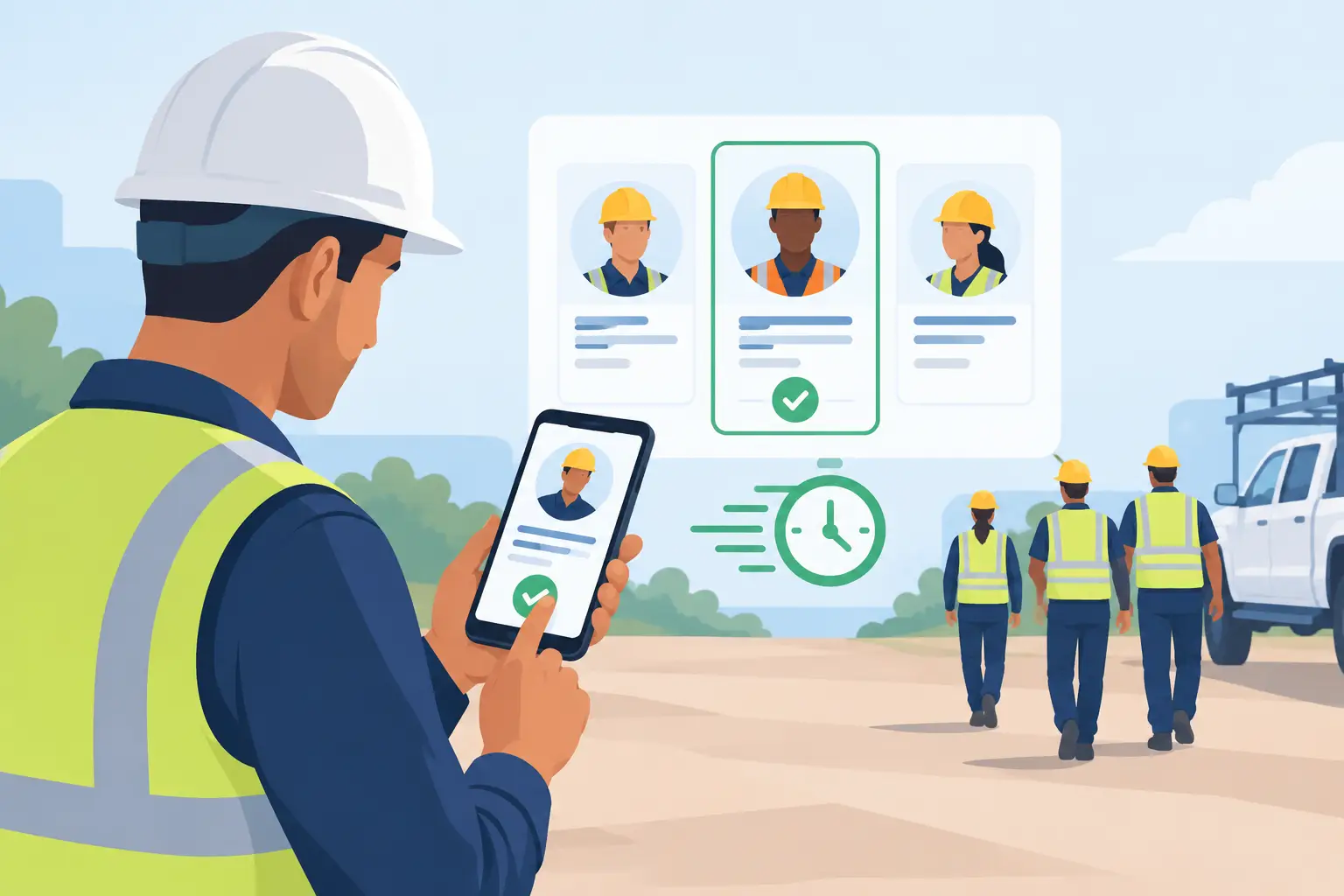
A superintendent learns at 6:30 a.m. that two electricians will not make it to a commercial buildout. The schedule does not pause, the inspection date does not move, and the crew cannot wait for someone to get back to a desk. That is where mobile recruiting for field crews changes the equation: it puts qualified candidates, proof of skill, and direct communication in the hands of the people responsible for getting work done.
For construction companies, mobile recruiting is not about adding another app to the hiring stack. It is about reducing the gap between a labor need and a dependable person arriving ready to work. For tradespeople, it is a faster way to find legitimate opportunities, show what they can do, and respond before a job is filled.
Why Field Hiring Breaks Down at the Desk
Traditional hiring systems were built around office workflows. A recruiter posts a job, waits for resumes, schedules calls, and moves candidates through several approval steps. That can work for a long-term corporate role. It rarely fits a project where a missing welder, plumber, or HVAC technician can affect production before lunch.
Field crews operate across changing locations, shifting scopes, and tight deadlines. Project managers may be walking a site when an urgent staffing need appears. Foremen may know exactly what skill is missing but have no practical way to reach available workers quickly. Meanwhile, qualified tradespeople are often on the move, between jobs, or unable to spend an hour completing a desktop application.
The result is familiar: employers hire from incomplete information, rely on the same limited contacts, or settle for candidates who have not been properly screened. Workers miss jobs because the process is slow, unclear, or buried in generic job-board noise.
Mobile-first hiring closes that gap, but only if it is designed around how trade work actually happens.
What Mobile Recruiting for Field Crews Must Do
A mobile recruiting process should help employers make a sound decision quickly, not merely collect more applications. Speed without verification creates expensive problems. A crew member who lacks the required license, cannot perform the work, or disappears after day one is not a fast hire. It is rework.
The strongest mobile workflow gives decision-makers immediate access to the information that matters: trade specialization, location, availability, licenses, certifications, relevant work history, and examples of completed projects. For workers, the same system should make it easy to present that proof without rebuilding a resume every time a new opportunity appears.
That means a strong candidate profile carries more weight than a name and phone number. A commercial electrician and a residential service electrician may share a title but bring very different experience. A portfolio showing panel work, conduit runs, finish work, or industrial installations gives an employer context before the first conversation.
Direct messaging matters, too. A candidate who can answer a few job-specific questions from a phone can move forward while the need is still active. But messaging should support a clear decision process, not replace it. The employer still needs to confirm scope, pay range, site requirements, start date, and whether the worker has the credentials needed for that assignment.
Build a Hiring Workflow That Works From the Jobsite
The best mobile process is simple enough for a project leader to use under pressure and structured enough to protect quality. Start by defining the job in terms a skilled worker can act on immediately.
Post the work, not a vague title
“Need carpenter” attracts broad responses and creates follow-up work. A useful job post identifies the trade, project type, location, expected duration, schedule, pay approach, required credentials, and the specific work involved. For example, framing experience, commercial tenant improvement work, OSHA requirements, or ability to read blueprints can be more useful than a long list of generic responsibilities.
This clarity helps qualified workers self-select into the opportunity. It also discourages applications from people who do not match the site conditions or skill level.
Screen for proof before scheduling a call
When time is tight, employers should review verified credentials and relevant project experience before moving candidates into interviews. A license or certification is not the full story, but it is a critical first filter where the role requires it. Employment validation, ratings, and work portfolios add the practical evidence that a resume alone cannot provide.
Use the first conversation to confirm the details a profile cannot settle: current availability, transportation, tools, comfort with the exact scope, and ability to meet the site start time. A five-minute mobile conversation can prevent a bad hire if the questions are focused.
Move quickly, but set a decision owner
Fast hiring can still stall when no one owns the final yes or no. On active projects, establish who can approve a worker, who verifies documents, and who sends onboarding instructions. If every candidate must wait for a chain of emails, the best people will accept another offer.
The goal is not to eliminate oversight. It is to make the handoff clear. A foreman may validate technical fit, a project manager may approve the labor need, and HR may complete final compliance steps. Mobile tools should help those people act in sequence without losing the candidate.
Keep the worker informed
Tradespeople remember employers who communicate clearly. If the job is filled, say so. If a background check or document review is pending, explain the next step. If the schedule changes, update the candidate before they arrange travel or turn down other work.
Reliable communication protects an employer's reputation in a tight labor market. It also helps build a bench of workers who may be right for the next project, even if they are not selected today.
Verification Is the Difference Between Fast and Risky
Construction hiring has a trust problem because the cost of a mismatch is high. One unreliable hire can affect safety, quality, schedule, crew morale, and customer confidence. Mobile recruiting should not ask employers to trade confidence for speed.
Verification creates a better middle ground. License checks help confirm that a worker meets role-specific requirements. Background checks may be appropriate depending on the employer, project, client requirements, and access to occupied facilities. Employment validation can provide another signal that the experience listed is real. Portfolios show the work itself.
No single signal guarantees performance. A verified profile does not replace a job-specific conversation, and a strong portfolio does not automatically prove a worker is available or right for a particular site. The value comes from combining signals so the employer can make a better decision with less back-and-forth.
For workers, verification has an equally practical benefit: it makes real experience visible. Skilled tradespeople should not have to compete solely on who submits an application first. Credentials, references, project photos, and employment history help the right employer recognize the value of their work.
Where Mobile Hiring Delivers the Most Value
Mobile recruiting is especially useful when labor demand is time-sensitive, geographically specific, or tied to changing project phases. A contractor may need additional masons for a short push, a service company may need an experienced HVAC technician before peak season, or a subcontractor may need licensed electricians after a scope change.
It is also valuable for ongoing workforce building. Not every role needs to be filled the same day. Companies can use mobile tools to stay connected with reliable workers, monitor availability, and create a more responsive talent pipeline before the next urgent need hits.
That said, mobile hiring is not the right answer for every decision. Senior leadership roles, highly specialized estimating positions, and long-term executive hires may need deeper interviews and a slower evaluation process. Even then, mobile communication can reduce scheduling friction and keep candidates engaged. The right approach depends on the role, the risk level, and the project timeline.
A Better Standard for Skilled Trade Hiring
A field-ready platform should make it easier to find qualified workers without forcing employers to choose between urgency and due diligence. That is the operating logic behind go2work: trade-specific profiles, credential validation, project portfolios, AI-powered matching, and direct communication built around the realities of construction staffing.
For employers, the practical standard is straightforward. Can you identify the right trade, verify fit, contact the worker, and move them toward a job without chasing incomplete information across texts, spreadsheets, and generic applications? For workers, can you show your skill, respond quickly, and pursue legitimate jobs from your phone?
When the answer is yes, hiring becomes less reactive. The next labor gap may still arrive before sunrise, but your team will be ready to respond with proof, speed, and a clear path to the right person.